
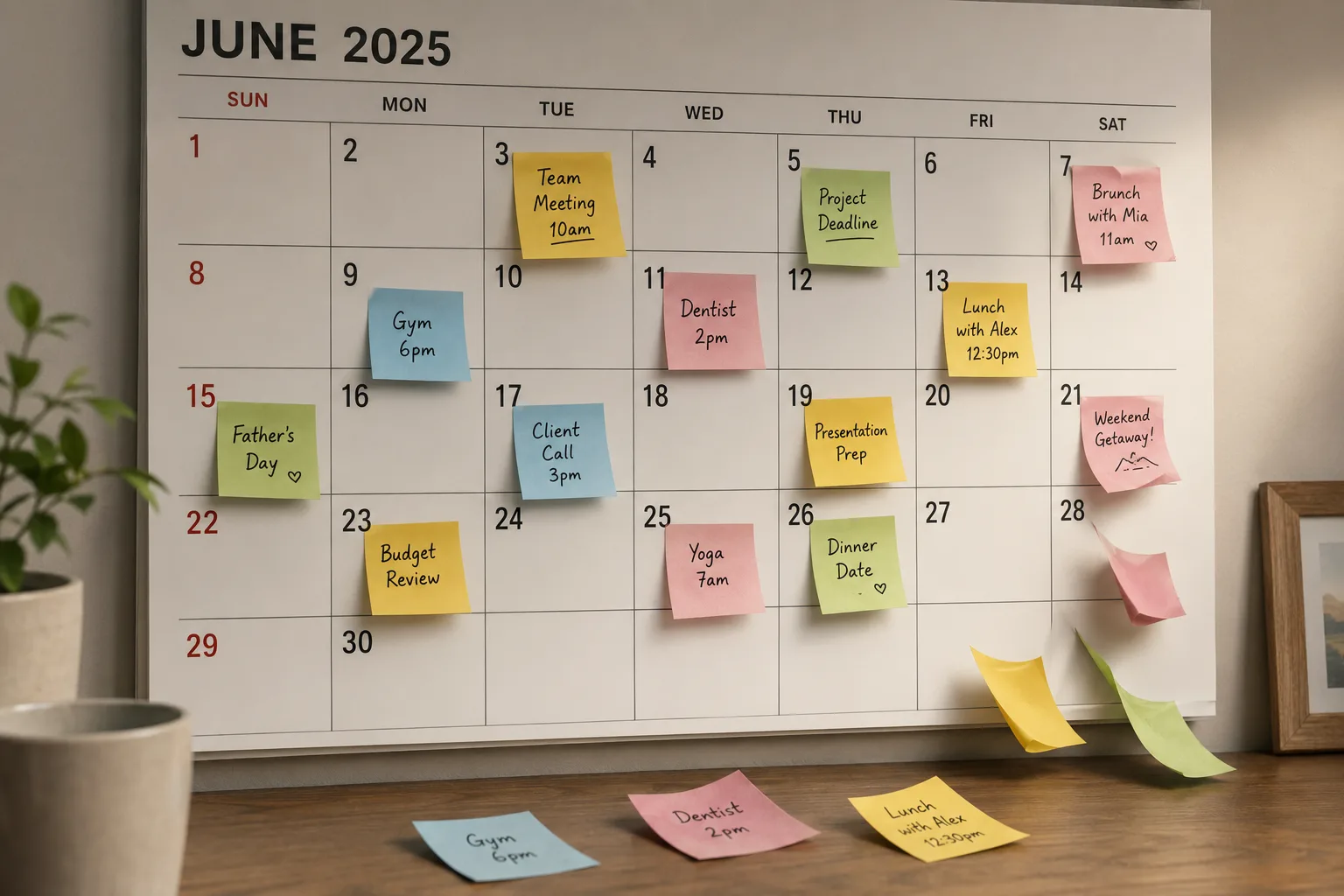
“I’ll spend less time on my phone this week.” You say it on a Sunday night and you mean it. By Tuesday lunchtime it’s gone. The Sunday version of you wasn’t lying. The Sunday version of you wrote down a vibe and called it a plan.
Goals nearly all die in the same spot. It’s the moment the intention has to survive a real bit of your actual day. More willpower won’t save it. What helps is a small change in how you write the goal down, and quite often, who else gets told about it.
What’s wrong with vague intentions
“Read more.” “Be on my phone less.” “Go to the gym.” None of these comes with a trigger. So your brain has to make the call again, from scratch, every single time. By Thursday, after a long day, that call goes the easy way.
The U.S. National Cancer Institute’s research-construct entry on implementation intentions lays out why cleanly. Wanting to do a thing doesn’t reliably make you do it. The gap between “I want to” and “I did” is wider than most people assume, and what bridges it is almost entirely a concrete plan for when and where the action happens.
What an if-then plan looks like
An if-then plan bolts the goal onto a specific cue. The shape of it is deliberately boring:
If [situation], then I will [action].
So “I want to read more” turns into If it’s 9pm and I’m in bed, then I’ll read for 15 minutes before opening my phone.
And “less Instagram” turns into If I unlock my phone in the kitchen, then I’ll put it back face-down before I open anything.
Koestner and colleagues showed back in 2002 that two things together do the heavy lifting: a goal you genuinely care about (what they call a “self-concordant” goal) and a concrete plan like this. Put together, they predict real follow-through far better than either piece does on its own.
Why other people change the maths
Matthews ran the most-cited experiment on the social side of all this, in a 2007 study at Dominican University. People who wrote their goal down, committed to a friend, and sent that friend a weekly progress update hit their goal at markedly higher rates than the people who wrote nothing. They beat the people who wrote it down but kept it to themselves, too.
This isn’t pressure or shame doing the work. Tell the right person, in the right way, and they end up holding your own intentions in their head for you. You stop having to white-knuckle the thing alone.
What to try today
- Rewrite one current goal as an if-then plan. Pick the one you keep missing. Add the trigger, add the action, and keep it small enough that you could do it tired.
- Tell one person. Not a podcast audience. Not the whole group chat. One person who knows you and won’t lecture you. Ask them to check in on a specific day.
- Make the first rep easier than you think you need. A 5-minute walk, not a 5km run. One page, not one book. Reps tend to live or die on how big the first one is.
- Pre-commit the failure mode. Decide now what you’ll do on the day you slip, because you will slip. “If I miss a day, then I do half tomorrow” stops a missed day turning into a missed week.
- Track in writing, briefly. One line, once a week, somewhere it’ll catch your eye. The record itself barely matters. What matters is marking that the goal’s still alive.
When to build a bigger system
Some goals are too big for one if-then to hold. Quitting something hard. Building a habit that actually sticks. Recovering from something. For those, a friend-update loop on its own won’t carry the weight, and you’ll want something more structured around you. Maybe a group that meets at the same time every week, whether that’s running, gym, recovery or study. Maybe paid coaching. Maybe therapy. The principle holds either way. Get the goal off raw willpower and onto a schedule and another person.
Asked by readers
Questions readers send us most often, with the pieces that answer each in full.