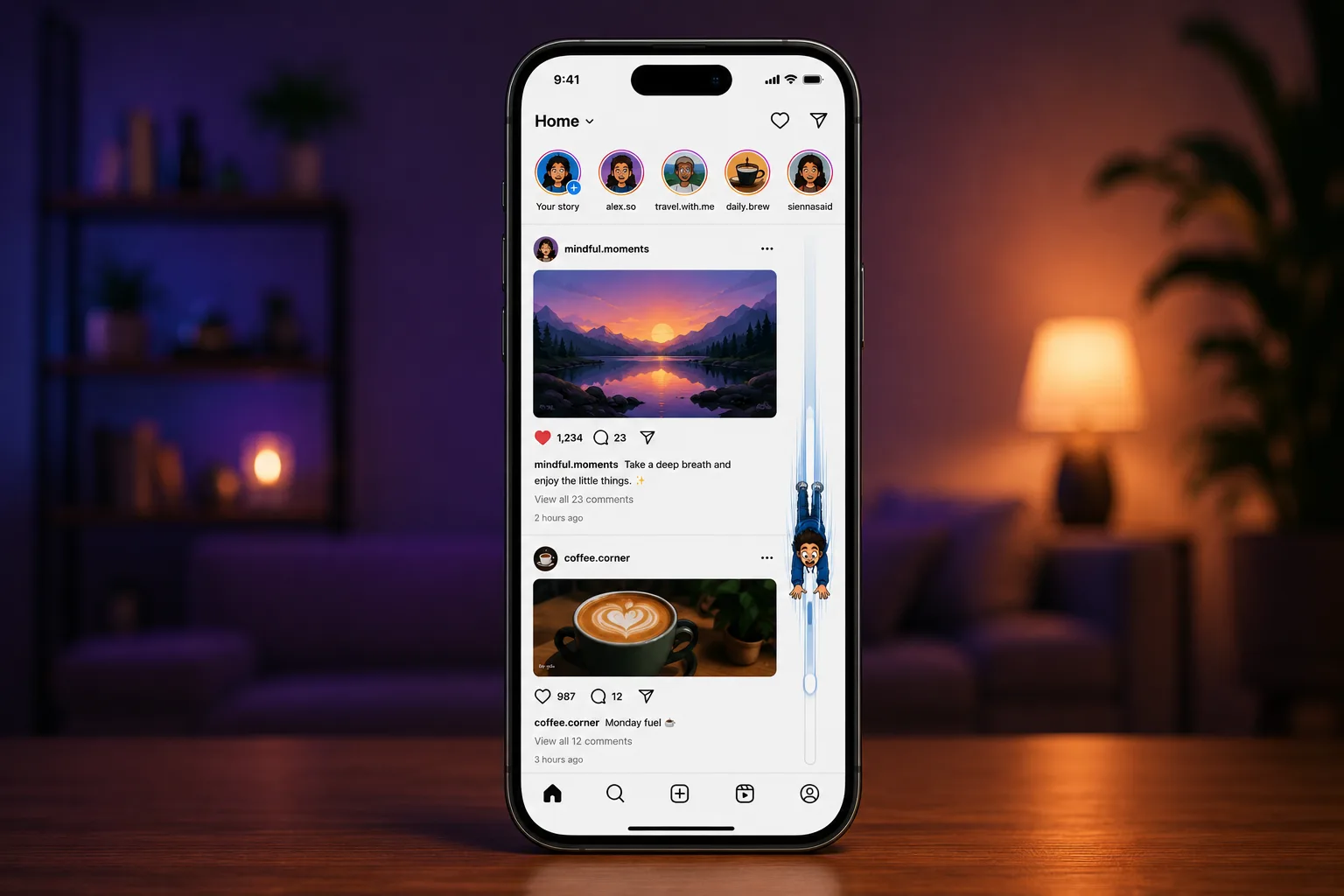
You meant to check the time. Forty minutes go by. The ceiling is the same colour it was, your shoulders have crept up towards your ears, and you couldn’t cleanly say what a single thing you just read was about. That’s the loop. Somebody built it on purpose, and it’s genuinely hard to climb out of once you’re in.
“Just stop” isn’t advice. It’s a wish dressed up as one. So here’s what the research and the public-health bodies actually say: why the scroll is so hard to leave, what you can do in the moment you’re already stuck in it, and how to make the next session less likely to kick off in the first place. (If the scroll has been around long enough that the foggy aftermath is starting to feel like your normal, you might recognise a bit of yourself in our piece on what brainrot actually is.)
Doomscrolling and phone addiction are the same engine
Most people googling how to stop phone addiction are really asking how to stop doomscrolling. The compulsive, anxious, hard-to-leave scroll is the load-bearing piece of the whole thing we loosely call phone addiction. They aren’t the exact same problem. But pull a lever on one and the other usually moves too. Sort out the scroll and you’ve sorted out most of the rest.
Why doomscrolling is hard to stop
Two things are going on at once. First, the feed itself. It’s built as an unpredictable mix of small reward and small alarm, with the next item already loading before you’ve finished the one in front of you. The American Psychological Association describes this exact loop as compulsive. Your brain keeps checking because the next check might be the one that finally resolves the uncertainty. It never quite is.
Second, there’s the state you were in when you picked the phone up. Cleveland Clinic notes that doomscrolling tends to begin with anxiety rather than interest. You reached for it because something already felt off. The scroll promises to make sense of that feeling. It almost never delivers. It just keeps you company while you wait for the feeling to pass on its own.
What scrolling actually does to mood and sleep
The APA links sustained doomscrolling to higher anxiety, lower mood and worse sleep. The CDC, in its broader guidance on social connection, points to a different cost. The time you sink into scrolling crowds out the contact that would genuinely help. A real conversation. A slow walk. Sleep itself. The Surgeon General’s 2023 advisory makes the same case. Digital contact often stands in for the kind of connection people need to feel well, without ever really replicating it.
So you end up in a bind. The loop doesn’t fix the thing it promised to fix, and the hours it eats are the exact hours you’d have spent on the things that would.
What to try in the moment (when you’re already in it)
- Name it out loud, or in your head. “I’m doomscrolling because I’m anxious.” Saying the thing weakens the autopilot more than any breathing exercise will. The whole scroll runs on you not noticing it’s happening.
- Move the body, not the thumb. Stand up. Walk to a different room. Open a window. You’re not trying to be virtuous about it. You’re trying to break the posture the loop depends on.
- Hide the next dopamine hit, not the app. Swipe to a different feed or a boring screen. The impulse runs on novelty. Starve it for thirty seconds and it usually fades enough to put the phone down.
- Switch to a slower input. A voice note to a friend. A book that’s already open near you. Music with no screen attached. Anything that asks a bit more of your attention than passive scrolling does.
- Don’t bargain with “five more minutes”. The scroll has perfect patience and you don’t. Five minutes is fifty.
How to make the loop less likely to start
- Greyscale your phone in the evening. Cleveland Clinic recommends this one specifically. Colour is doing more work than you’d think. Take it away and the apps lose a surprising amount of their pull.
- Move the worst apps off the home screen. Don’t delete them. Just shove them one swipe further away. That half-second of friction is enough to break the autopilot reach.
- Set a daily cap and let other people see it. Solo limits collapse the second you’re tired. The research on accountability is consistent here. The limit that holds is the one a friend can see. That’s the mechanism Offbit is built around.
- Identify the trigger window. Most doomscrolls have predictable peaks. Bed. Waking up. The half-hour after an awkward meeting. Pick a small replacement for those windows in advance. A loaded kettle, a book on the pillow, a route through the door that doesn’t end at the sofa.
When to get extra support
Sometimes the scrolling is sitting on top of something heavier. Low mood that won’t lift, anxiety that doesn’t pass, thoughts you’re scrolling to get away from. When that’s the case the phone is the symptom and not the engine. The NHS self-help page for anxiety is a sensible first step, and in the UK you can self-refer to NHS Talking Therapies without a GP appointment. Treat the mood underneath and the scrolling usually comes along with it.
Asked by readers
Questions readers send us most often, with the pieces that answer each in full.