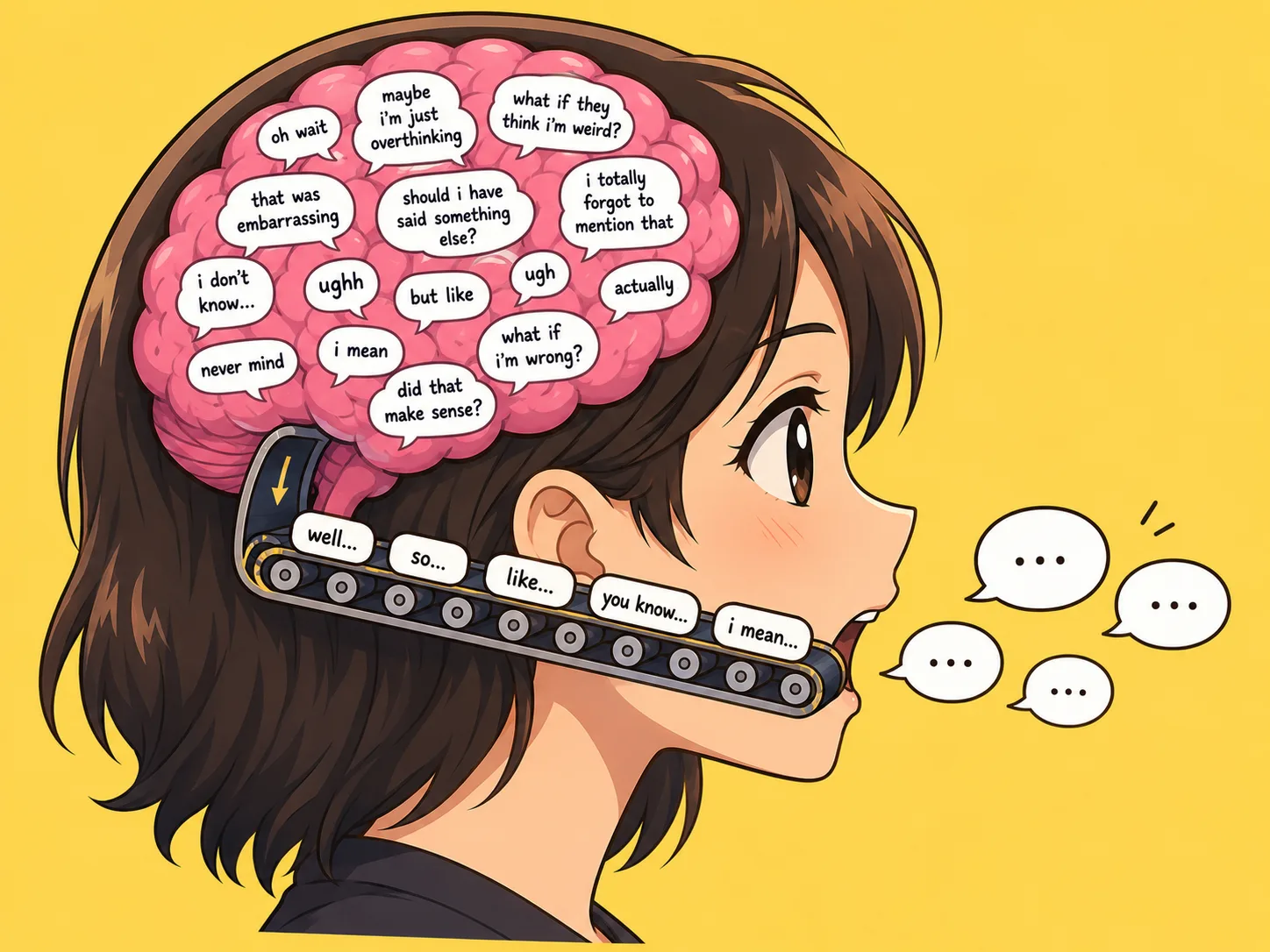
A second ago you knew exactly what you wanted to say. The thought sat there, whole. Then somebody turned and looked at you, the room shifted, and the sentence just dissolved somewhere in your throat. Two filler words bought you nothing while your brain spun its wheels. By the time the actual point showed up, everyone had already moved on.
If that reads like an uncomfortable mirror, you’re in very ordinary company. Going blank, losing the thread, reaching for a word that isn’t there. Three separate public-health bodies list these by name as part of how anxiety messes with everyday thinking. It’s a documented thing, not a quirk of yours.
What’s happening when the words don’t come
Under pressure, your brain quietly reshuffles what it’s paying attention to. The working memory that usually fetches the right word at the right moment is suddenly busy with the room instead. Facial expressions, the sound of your own voice, whether you’re coming across okay, what you’ll say next. Sudden difficulty finding words when speaking is one of the most common ways this shows up. The NHS lists trouble concentrating and difficulty thinking clearly among the standard symptoms of anxiety. Cleveland Clinic describes brain fog as that feeling of having lost your train of thought, or groping for a word that won’t arrive.
None of this is about intelligence. The word is right there. You just can’t get a clear run at it for a few seconds.
Why it hits harder with people you want to impress
Stakes turn up the background noise. The more you want to do well, the more of your attention goes to checking how you’re doing. And that watching draws on the exact same bandwidth as the speaking. Most people can manage one of those properly at any given moment. Doing both at once is the part that breaks.
NIMH lists “mind going blank” as a recognised feature of social anxiety. It’s not a personality flaw, and it’s definitely not a sign you don’t know your stuff. The blank comes from the watching. The watching is the thing to look at.
When it might not be “just anxiety”
All sorts of things can leave your head feeling stuffed with cotton wool. A week of bad sleep. The tail end of a virus. ADHD, perimenopause, a new medication, not drinking enough water. Or, more often than anyone likes to admit, just being hungry. If the blank feeling is most days, most weeks, and trending worse rather than better, take it to a GP. It might still be anxiety. It might be something else entirely, with a different name and a more specific fix.
And if what you’re feeling sits more in the fuzzy-head, slow-thinking camp than the tongue-tied-under-stares one, the piece on anxiety and brain fog covers that side of it better. The two overlap far more than their names let on.
What to try today
- Buy yourself a beat. “Let me think for a second.” Most people hear that as confident, not lost. The pause works in your favour.
- Don’t script the whole sentence. Grab the first three words and trust the rest to follow. Mental scripts tend to collapse the second the conversation veers an inch off where you expected.
- Name it, quietly, to yourself. A small internal “ah, this is the anxious-blank thing” shrinks the moment back down to something familiar. You don’t need to fix it on the spot. You just need to clock it.
- Drop the sensory load before anything that matters. A loud café, your phone buzzing, three tabs of feeds open in the background. All of that is quietly eating working memory you’d rather spend on the person in front of you. The NHS self-help page for anxiety basically opens with: do less at once.
- Sleep, food, water. Boring, and load-bearing. Most “I can’t think straight” days have one of those three sitting underneath.
When to get extra support
The odd anxious blank is normal. Blanks that keep coming, get worse, and start steering your decisions are a different story. If you’re calling in sick to dodge work, sidestepping people you actually like, or finding the whole loop too much to manage alone, the NHS anxiety self-help page is a sensible first stop. Your GP can refer you into talking therapy in the UK without anything dramatic having to happen first. You don’t have to be in crisis to ask.
Asked by readers
Questions readers send us most often, with the pieces that answer each in full.